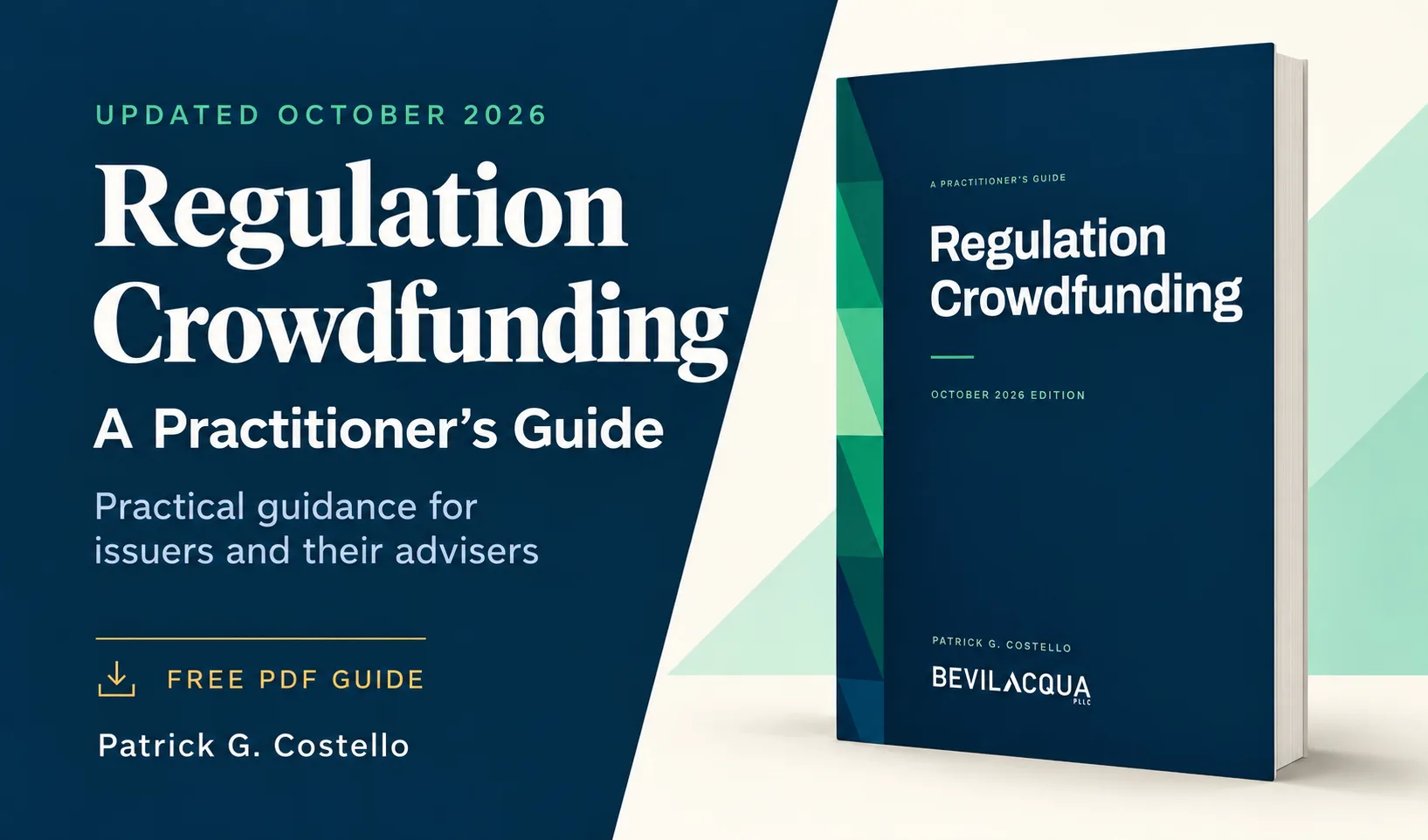
Regulation Crowdfunding (Reg CF) allows eligible companies to raise up to $5 million in a rolling 12-month period from both accredited and non-accredited investors through an SEC-registered intermediary. For startups and growing businesses, it offers a way to reach investors beyond traditional financing sources. Preparing an offering requires careful attention to the company's eligibility, financial statements, disclosures, investor communications, and obligations after the offering closes.
I have updated Regulation Crowdfunding: A Practitioner's Guide to help entrepreneurs, management teams, and their advisers understand these requirements and plan their offerings. The October 2026 edition builds on the prior guide with expanded practical explanations, illustrative examples, planning tables, and discussions of the legal and business considerations involved in a Reg CF campaign.
The updated guide covers:
- Understanding Reg CF: The offering framework, the $5 million limit, investor eligibility and investment limits, and the role of registered funding portals and broker-dealers.
- Planning the offering: Launch schedules, financial statement preparation, and budgeting for legal, accounting, intermediary, marketing, and ongoing compliance expenses.
- Determining issuer eligibility: Which businesses may use Reg CF, disqualifying events, and the effect of prior reporting compliance.
- Preparing Form C: Business and offering disclosures, risk factors, use of proceeds, ownership and capital structure, related party transactions, and the applicable financial statement requirements.
- Managing investor communications: Testing the waters before filing, post-filing advertising, platform communications, and compensated promoters.
- Administering the offering and ongoing reporting: Investment cancellations and reconfirmations, early closings, offering amendments, progress reports, annual reports, and the conditions for ending reporting obligations.
- Using crowdfunding vehicles: The Rule 3a-9 co-issuer structure, corresponding securities and investor rights, joint Form C disclosure, and shareholder-count considerations under Exchange Act Section 12(g).
- Understanding transfer restrictions: The limits on reselling Reg CF securities and why the end of a holding period does not itself create a trading market.
This edition gives greater attention to the practical work behind an offering. It includes expanded marketing-budget and cost-planning discussions, guidance on preparing for EDGAR Next filings, and additional explanations of financial statement requirements and ongoing reporting. It also addresses how investors holding through a crowdfunding vehicle affect the analysis of when annual reporting may end, separately from the shareholder-count rules under Section 12(g).
The guide is intended to help you evaluate whether Reg CF fits your financing plans, anticipate the work and expense involved, and coordinate with your legal, accounting, and intermediary teams. Its examples and cost estimates are planning tools; actual requirements, timing, and expenses depend on your company's circumstances and offering structure.
To discuss a potential Reg CF offering or other capital-raising options, contact Patrick Costello at Patrick@bevilacquapllc.com or (202) 869-0888, extension 130.
About Patrick Costello
Patrick Costello is a Senior Associate at Bevilacqua PLLC, where he advises companies on federal securities law, corporate governance, capital raising, and complex transactions. His practice includes private placements, equity crowdfunding campaigns, Regulation A offerings, registered public offerings, and related disclosure and compliance matters.
Before joining the firm, Patrick served as an Examiner in the Division of Corporation Finance at the U.S. Securities and Exchange Commission. He uses that regulatory background to help clients navigate securities offering requirements, public company disclosure obligations, and practical business planning issues.
Patrick earned his J.D. from Wayne State University Law School and holds an LL.M. in International Business and Economic Law and a Securities and Financial Law Certificate from Georgetown University Law Center.
View Full Professional Bio | Connect on LinkedIn
This post contains general information. This post is not intended: (a) to convey or constitute legal advice on any subject matter; (b) to establish an attorney-client relationship; or (c) to be a solicitation. Also keep in mind that prior results in a legal matter do not guarantee a similar outcome in another legal matter.
Share this article


